There's no universal number
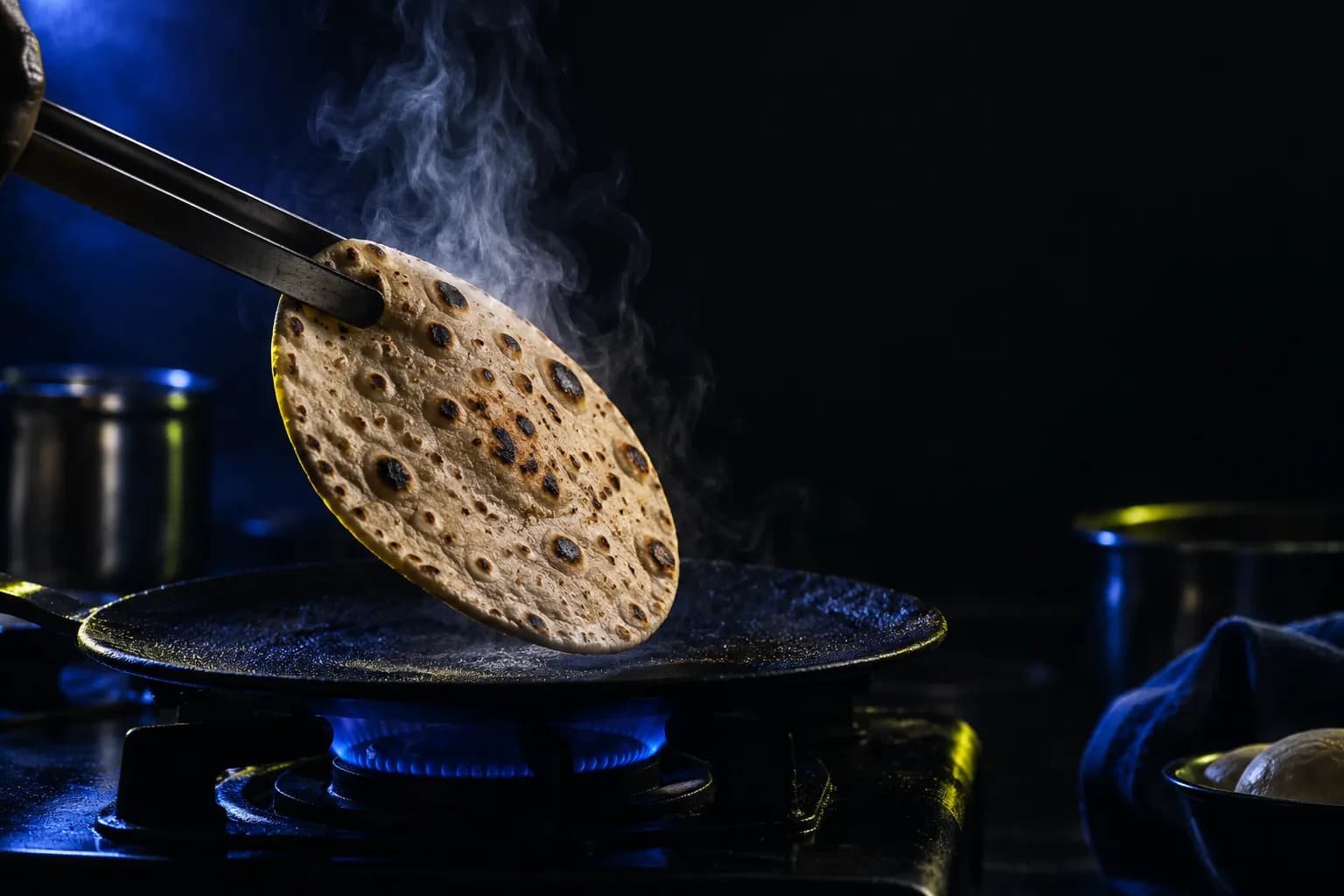
Roti gets blamed for weight gain more than almost any other Indian staple, and it's mostly undeserved. A plain roti is a moderate-calorie, high-fiber, unrefined-carb food. The question "how many rotis a day?" doesn't have one correct answer because it depends entirely on two things: your total daily calorie target, and how many calories the rest of your plate — dal, sabzi, rice, oil, ghee, dessert — is already using up. Two people eating the exact same number of rotis can be on completely different calorie trajectories depending on everything around the roti.
What a roti actually costs
The numbers below are for one medium (6-inch) roti, based on standard Indian food composition data:
- Plain roti/phulka (30 g atta, no ghee): about 95 kcal, 3.2 g protein, 3.4 g fiber
- Roti with 1 tsp ghee: about 140 kcal — the ghee alone adds roughly 45 kcal
- Bajra roti (pearl millet, 35 g flour): about 119 kcal, 3.9 g protein, 4 g fiber
- Jowar roti/bhakri (40 g flour): about 131 kcal, 4 g protein, 4.1 g fiber
Notice that jowar bhakri and roti-with-ghee land at similar calorie totals — the millet roti isn't meaningfully "lighter," it's just built differently (more fiber and micronutrients per calorie, not fewer calories).
The real lever isn't the roti
The single biggest calorie swing on a roti isn't the roti itself — it's what you put on it and next to it. One teaspoon of ghee adds roughly 45 kcal, which is nearly half the calorie value of the roti it's sitting on. Two or three rotis generously buttered can easily out-calorie four or five plain ones. Portion size (a "medium" roti at home is often bigger than 6 inches) and what's served alongside — a deep-fried sabzi, extra rice, a sugary drink — usually matter far more than the roti count on its own.
Roti isn't the villain — the ghee, the portion size, and everything else on the plate usually are.
Worked examples
Here's how the same question plays out at two different calorie targets, assuming a typical thali-style meal with dal, sabzi, and a small salad alongside the roti (roughly 350–400 kcal from the rest of the plate per meal):
- 1,600 kcal/day target, 3 meals: after allowing roughly 380 kcal per meal for dal/sabzi/sides, you have room for about 2 plain rotis (190 kcal) per meal, or 1–2 if ghee is involved.
- 2,200 kcal/day target, 3 meals: with roughly 400 kcal per meal for sides, you have room for 3–4 plain rotis per meal comfortably, or 2–3 with ghee.
These are illustrative, not prescriptive — your actual numbers depend on your personal calorie target and what you're eating alongside the roti. The point is that the right number of rotis is a downstream calculation, not a fixed rule.
What about millet roti?
Bajra, jowar, and ragi rotis are often marketed as automatically "better for weight loss," but the honest picture is more modest: they carry similar or slightly higher calories per roti than plain wheat roti, with meaningfully more fiber and a different micronutrient profile (more iron, calcium, or magnesium depending on the grain). The fiber can help with fullness and digestion, which indirectly supports eating less overall — but swapping to millet roti alone, without addressing total calories and portion size, won't produce fat loss on its own. Treat millet rotis as a nutritious variation worth rotating in, not a calorie loophole.