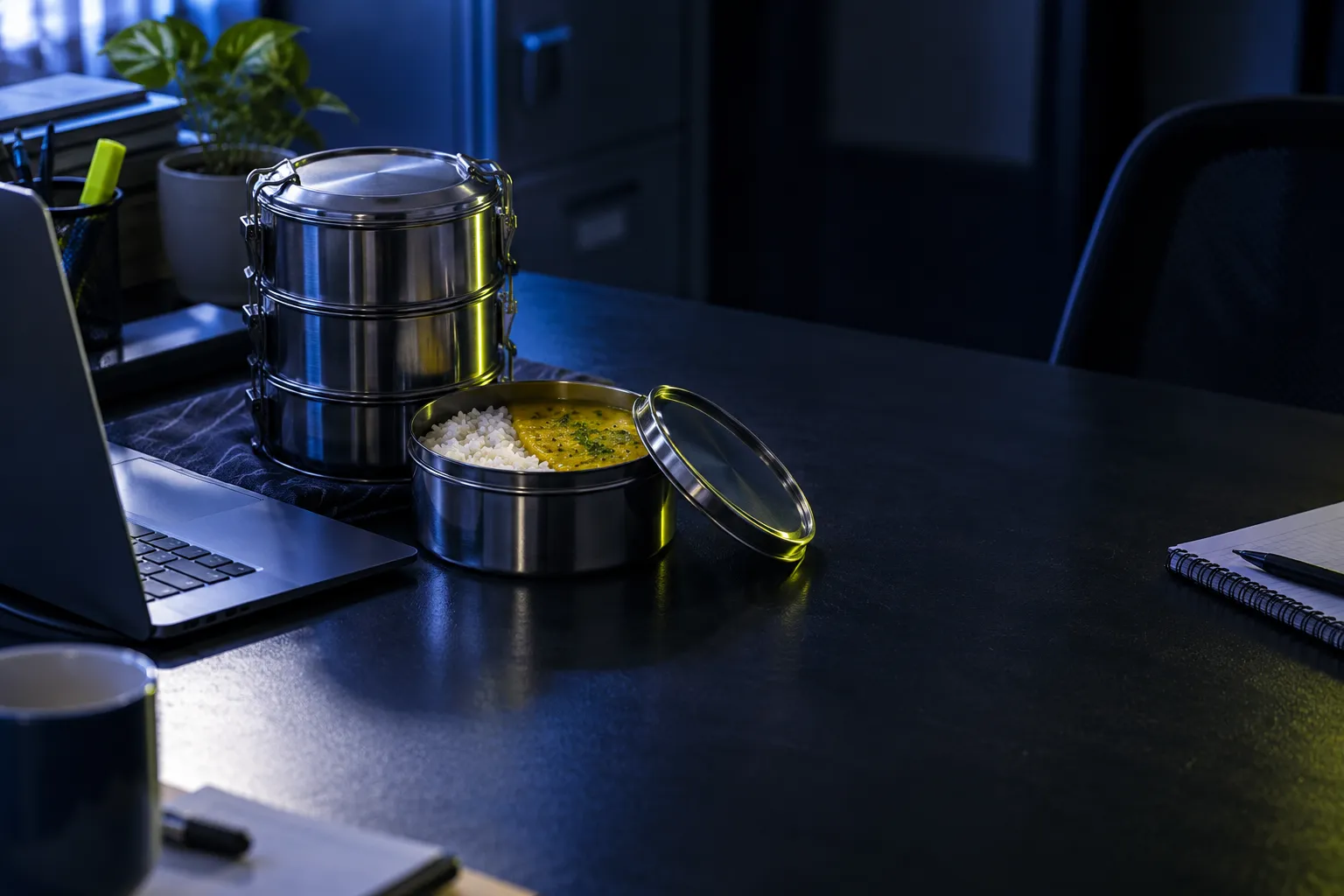
What makes a tiffin work
A tiffin that supports a fat-loss or muscle goal is not a special diet tiffin — it's the same dal-roti-sabzi most Indian households already make, built with three things in mind: a protein anchor, enough fibre to keep you full past 4pm, and portion awareness on the rice or extra roti. Nothing exotic, nothing that needs a separate shopping list.
A standard home dal-roti-sabzi tiffin — 3 roti, a katori of dal, a katori of sabzi — already carries a genuinely useful 526 kcal and about 19.4 g of protein. That's not a "cheat" version of a diet plate; it's the plate most people already pack, and it holds up well against most calorie and protein targets for a midday meal. The gap most tiffins fall into isn't the wrong food — it's a thin dal, a skipped protein side, or three extra roti eaten on autopilot.
Three templates that work
These use ordinary home-cooked items — nothing you can't make in a normal Indian kitchen.
- The classic dal-roti-sabzi dabba. 3 roti + 1 katori dal (toor or moong) + 1 katori sabzi. Roughly 526 kcal and 19.4 g protein. This is the anchor template — build every other option as a variation on this ratio of grain to dal to vegetable.
- Rice-based regional plate. A katori of rajma or a curd-rice base (curd rice alone runs about 484 kcal and 14.5 g protein) plus a small bowl of sprout salad on the side adds roughly 100 kcal and another 7 g protein — pushing the plate closer to 20+ g protein without adding any meat or dairy beyond what's already there.
- Sandwich-and-side for a lighter tiffin. A home-style paneer sandwich (about 331 kcal, 15.5 g protein) with a boiled egg or a small bowl of sprouts on the side is a genuinely quick option for days you're packing in a hurry, and still lands a reasonable protein number for a midday meal.
The tiffin that works isn't a diet tiffin — it's your usual dal-roti-sabzi with a protein side that doesn't get skipped.
These templates work whatever your regional staple is. A South Indian sambar-rice plate lands around 405 kcal and 11 g protein on its own — add a small bowl of curd or a boiled egg and it sits comfortably alongside the dal-roti template. A rajma-chawal plate runs about 423 kcal and 13.9 g protein and, like sambar rice, already pairs a cereal with a pulse, which is a genuinely useful combination for amino-acid completeness, not just a taste preference passed down in the kitchen.
Handling canteen days
Not every day allows a packed tiffin. On canteen or cafeteria days, a rough decoder helps more than trying to calorie-count a buffet line:
- Pick first, then plate. Choose dal, a paneer or egg curry, and a vegetable sabzi before you get to the rice or naan station — deciding your protein and vegetable first stops you from filling the plate with only carbs.
- Go light on the second serving of rice or naan, not on the dal or sabzi. It's almost always the third roti or second ladle of rice that pushes a canteen plate over, not the vegetable side.
- Watch the gravy, not the protein. A paneer or chicken item cooked in a thick, ghee-heavy gravy (butter masala, korma-style curries) carries far more calories than the same protein in a drier preparation (bhurji, tandoori, tawa). The protein itself is rarely the problem.
- Add whatever raw salad or curd is on offer. It's free volume and fibre that helps you feel full without adding much to the plate.
Making it sustainable
The realistic failure mode for tiffins isn't knowledge, it's Sunday-night energy. A few habits make packing a working tiffin the default rather than the exception:
- Cook dal in a slightly larger batch — a pressure cooker doesn't take meaningfully longer for double the quantity, and dal keeps well refrigerated for 2-3 days.
- Sprout a batch of moong at the start of the week; it needs no cooking and adds a genuinely cheap protein-and-fibre boost to almost any plate.
- Boil a batch of eggs on a day you're already in the kitchen — they keep for several days and turn any sandwich or salad into a higher-protein option in seconds.
- Roll extra roti dough and keep it in the fridge for a day or two rather than deciding fresh each morning — the friction of "what do I pack" is usually bigger than the friction of actually cooking.
The bottom line
You don't need to eat differently to make your tiffin work for your goal — you need to make sure the protein side doesn't get skipped and the extra roti or rice doesn't sneak in on autopilot. A standard dal-roti-sabzi dabba already does most of the job; the templates above are just small, realistic tweaks on what most Indian kitchens already make.